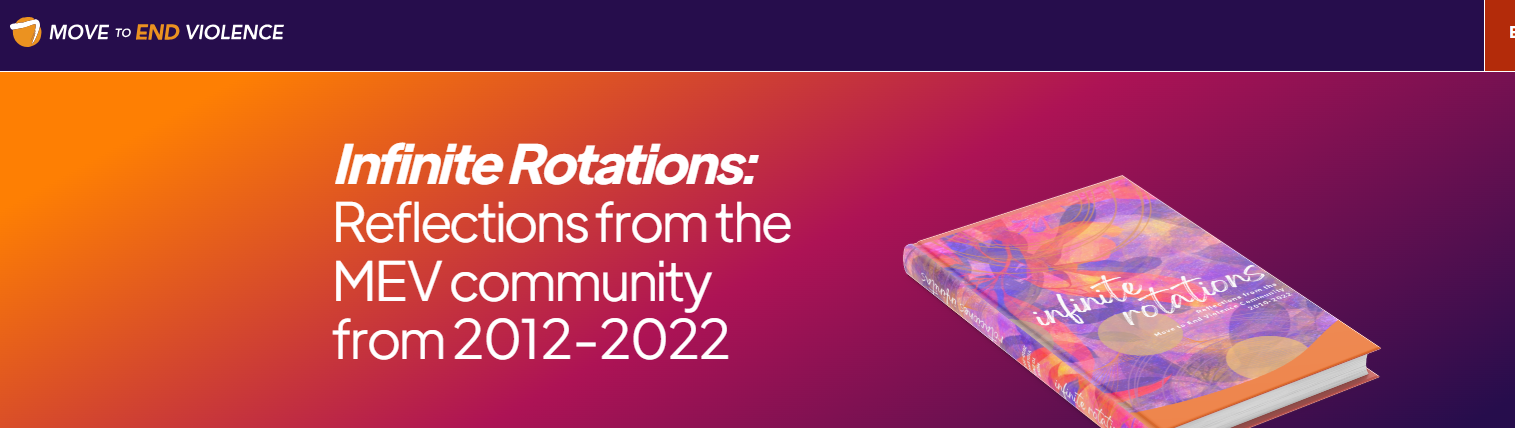
Published in Infinite Rotations Anthology: Reflections from the Move to End Violence (MEV) community from 2012-2022
We will take turns.
“Self-care is bullshit”, I remember her saying.
“It’s a way for patriarchy to convince us to opt out of organizing and resisting. If I stop, people literally die”.
It was 2015 and I was in a room in Brooklyn with Black women who had built an organization for survivors of patriarchy, misogyny, and White Supremacy. I was there as an Organizational Development Coach to support the group to integrate key concepts of the Move to End Violence program. This particular conversation was focusing on learning self-care practices by individuals within the context of organizations that deal daily with violence and trauma, and are frequently led by survivors of violence and trauma[1].
We all sat in silence for a moment. My mind raced. This was an organization that serves women and girls of African descent, many of whom were survivors of sexual violence. Many of whom have been denied bodily sovereignty and dignity both inside and outside of their communities. And this was a leader I knew to be deeply rooted in the needs of her community.
She was right.
I thought about other organizations I was working with who were responding that year to similar oppressions and traumas. As well as to literal wildfires, flooding, displacement, and the decision to end Deferred Action for Childhood Arrivals (DACA). Too much was at stake.
“The stakes often feel higher for BIPOC leaders because many feel a sense of responsibility to undo the long legacy of historical trauma and address the urgent needs faced by their communities… In our quest to change the world, we sometimes forget the emotional labor involved in fighting for social justice and the need to sustain ourselves and our staff in the face of formidable challenges we encounter”[2].
Self-doubt creeped in. I took a breath. We all took a breath. This was not mine alone to solve. This was ours to explore. We breathed into curiosity and simultaneity.
And we began to talk about both self-care and collective care. “When we neglect this part of our work – community care – we increase the chances that our exhaustion and emotional labor will turn into frustration, criticism, disconnection from each other, and eventually burn out.[3]”
On the cover of the workbook we each held was the Move to End Violence logo. It represents a flock of geese flying in a V formation. MEV chose this symbol because geese so powerfully model the beauty and strength of shared leadership and collective action.
What if, we wondered, we changed one word?
Instead of, “If I stop, people die”,
it was…
“If WE stop, people die”?
What might shift then?
The conversation changed in that moment. We talked about moving forward towards the same shared purpose horizon. About being aware of our individual and collective strengths and how that contributes to the ecosystem. About changing positions and trading off who is in the lead or carrying a lot. We talked about care for each other, about supporting those who are injured or fatigued to stop to rest and then return to the group when ready. We turned away from the notion of the solo, heroic leader who must sacrifice and do it all. We embraced instead the interdependence of shared leadership[4]–how it allows different strengths to shine at different times, is stronger than the sum of its parts, and allows the group to go farther than any could hope to go alone.
It was a transformative moment. And it has stayed with me all these years. I share this story often. It reminds me of others I’ve heard along the way…
We will carry a community.
Between 2013-2019, the Polynesian voyaging canoe Hōkūle’a* navigated the Mālama Honua Worldwide Voyage. It was guided by indigenous wisdom and a commitment to protect our natural ecosystems. While it might have been easier (financially and otherwise) to hire a crew of 12 professionals to sail around the world, the project chose a different path. Instead, the Hōkūle’a carried a community. Ultimately, 30 teams and nearly 300 people traveled the 60,000 miles. However, over 21 legs of the voyage, each person only sailed an average of twice in 3 years.
Navigators study the stars, the sea, the legs of the journey. They are always in relationship to the ocean and the heavens, orienting and re-orienting. It is both an academic and a spiritual journey that requires tremendous focus and an alarming lack of sleep – up 23 hours a day for weeks at a time.
Because a core strategy was to inspire, educate, and elevate a new generation of navigators by 2026, the crew was made up of young apprentice navigators who demonstrated the intellectual capacity to problem solve their position daily. Given time, the intention was to develop the wayfinding skills necessary to navigate patience, time, and maturity. “These new leaders will possess and demonstrate the Navigator Mindset—the courage to face the coming storms, the responsibility to act as stewards for our planet, and the resilience to rise to the challenges of a rapidly changing world”.
These apprentice navigators were away from land and from family for great lengths of time. They were deprived of sleep, subjected to harsh conditions. However, they did not participate in every leg of the journey, which would be impossible to sustain and ultimately, put the crew, the canoe, and the purpose at risk. Instead, they stepped back while others stepped forward. In this way, leadership and the work were shared and distributed. In this way, it became more sustainable, more possible.
We will sing while you breathe.
In 2018, a talk circulated by Keara Ette about ‘staggered breathing.’ in music. “It looks at a note that is too long for one person to hold. It’s just too long; it’s not physically possible. And yet it can be held, and it is held, by the whole — the whole body, the whole choir or the orchestra. It is the strength of the whole that lets that note be carried forth. This staggered breathing image helps me, to say there are moments when I need to break and breathe and there are moments when you need to break and breathe. And so when I’m taking a break because I need to, I know that you’re still singing. And then I will jump back in so that you can take your break and breathe because you have to.”
How will we possibly navigate this moment when we’re all so exhausted and when so much is at stake?
We will take turns.
We will carry a community.
We will sing while you breathe.
*********
Reflections by Michelle Gislason
Organizational Development Coach, Move to End Violence Initiative
*I was introduced to the Hōkūle’a from applied Zen teacher Norma Wong Roshi and Na’alehu Anthony -- Hōkūle’a crew member, captain, and producer of MOANANUIĀKEA: ONE OCEAN. ONE PEOPLE. ONE CANOE. To be in space with them and hear their stories has been one of the greatest gifts of my lifetime. A deep bow of gratitude to them both.
[1] MEV Self-Care for Sustainability and Impact Workbook https://www.nsvrc.org/sites/default/files/2021-02/Self%20Care%20Workbook%20FINAL.pdf
[2] Love Notes to Our Social Justice Leaders, Strategies for Social Change, LLC
[3] Love Notes to Our Social Justice Leaders, Strategies for Social Change, LLC
[4] https://movetoendviolence.org/blog/leadership-transitions-new-co-director-opportunity/